
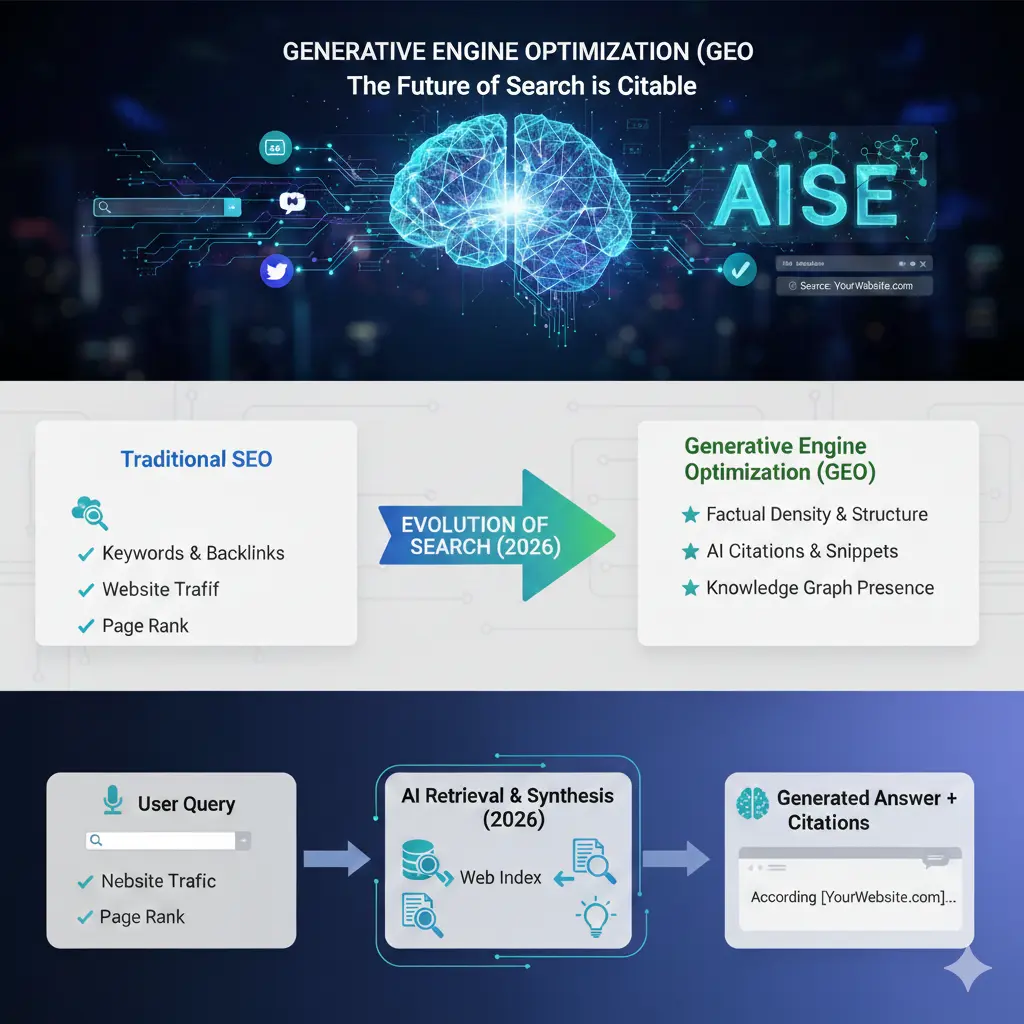
What is GEO? The Ultimate Generative Engine Optimization Guide (2026)
Direct Answer: Generative Engine Optimization (GEO) is a digital marketing strategy used to increase a website's visibility in AI-powered search engines like Google SGE, Perplexity, and Gemini. It focuses on **Retrieval-Augmented Generation (RAG)** principles to ensure content is cited as a primary source.
🌐 The Evolution: Why SEO is Shifting to GEO
By 2026, the traditional SERP (Search Engine Results Page) has transformed. Instead of a list of links, users now receive **synthesized AI Overviews**.
To rank today, your content must serve as a "knowledge chunk" that AI models can easily retrieve, verify, and cite. If you aren't optimized for GEO, your brand becomes invisible in the AI-first era.
🚀 The 5 Pillars of a High-Ranking GEO Strategy
1. High Factual Density
Eliminate fluff. AI prioritizes "Information Gain." Every sentence should provide a new fact, statistic, or verifiable claim.
2. Citation Signals
Incorporate external citations. Use phrases like "(Source: Industry Report 2026)" to signal academic-level reliability.
3. Entity Optimization
Define clear relationships between topics (Entities). Connect 'GEO' with 'LLMs', 'RAG', and 'NLP' to build topical authority.
4. Modular Chunking
Structure HTML into clear, digestible sections. Keep paragraphs under 3 lines to aid AI text extraction bots.
⚙️ Understanding RAG: The Engine Behind GEO
Most generative engines use **Retrieval-Augmented Generation (RAG)**. They pull data from the web and "remix" it into an answer.
⚔️ GEO vs. SEO: 2026 Comparison
| Feature | Traditional SEO | GEO (AI-First) |
|---|---|---|
| Primary Goal | Keywords & Links | Factual Citations |
| Unit of Rank | Whole Webpage | Information 'Chunks' |
| Success Metric | Organic Clicks | Brand Attribution |
Pro Tactic: The "Citation-First" Method
To get cited by Perplexity or SearchGPT, include a dedicated "Sources & Data" section. AI engines prioritize content that mimics the structure of academic papers and verified news reports.
❓ Frequently Asked Questions (GEO 2026)
1. How do I start GEO with existing content?
Add a 100-word summary at the top of your blogs and use clear H3 headers that answer specific "How-to" or "What is" questions.
2. What are the best tools for GEO analysis?
Use Semrush AIO, Perplexity (to check citation sources), and Google Search Console to track AI Overview impressions.
3. Does word count matter for AI ranking?
Quality and density matter more than length. A 500-word factual article will beat a 3,000-word fluff piece in GEO.
4. Can I use AI to write for GEO?
Yes, but ensure you add unique data, personal experience, and verifiable citations that the AI doesn't already have in its training data.